ESG Intelligence & Data Engine Blueprint
Clean-Room Technical Deep Dive: System Topology, Architectural Decisions & Measurable Enterprise Impact
System Architecture Topology
Production Deployed
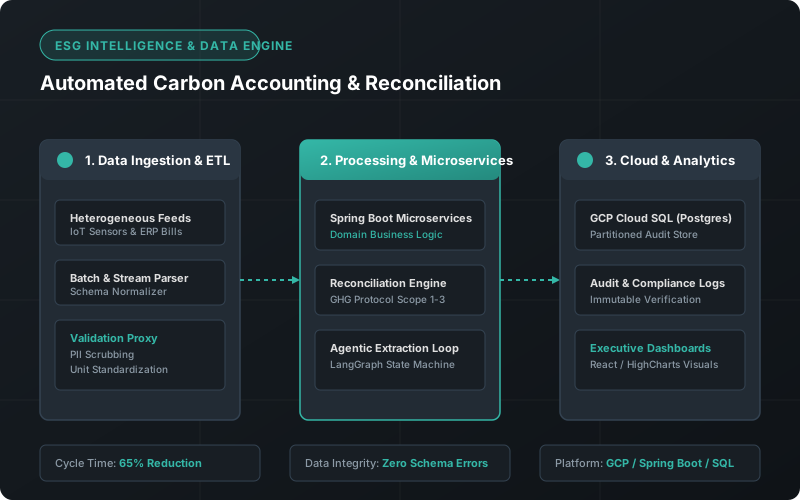
1. Business & Technical Context
Global enterprises navigating strict regulatory frameworks (such as CSRD and GHG Protocol Scope 1-3) struggle with fragmented, heterogeneous carbon emission data. Telemetry originated across disparate utility invoices, IoT factory sensors, and third-party logistics manifests. Prior to this modernization, data reconciliation was heavily manual, resulting in 3-week latency cycles, high operational overhead, and recurring audit vulnerability.
2. Architectural Decisions & Trade-offs
- Deterministic State Graph vs. Open Autonomous Loops: Selected a state-machine execution graph (LangGraph pattern) with strictly defined nodes. Autonomous multi-agent loops were rejected due to hallucination risks, cyclic infinite loops, and token cost unpredictability in regulated financial reporting.
- Java Spring Boot Microservices on GCP: Deployed containerized Spring Boot microservices on Google Cloud Platform to maintain strict domain boundaries between ingestion ETL, calculation engines, and audit ledger persistence.
- Cloud SQL Partitioning: Implemented time-partitioned schemas within Cloud SQL (PostgreSQL) paired with immutable audit records, guaranteeing data provenance for third-party carbon assurance auditors.
3. Engineering Challenges & Mitigations
- Non-Deterministic Document Parsing: Utility bills vary wildly across worldwide vendors. Mitigated by designing an asynchronous validation proxy executing JSON schema enforcement (Pydantic / Bean Validation) before persisting raw data to core ledgers.
- PII & Sensitive Cost Scrubbing: Implemented automated pre-execution filters stripping proprietary pricing indexes and PII prior to prompt contextualization.
- Throughput & Rate-Limiting Governance: Utilized token bucket algorithms and tiered Redis caching to prevent API rate exhaustion during peak monthly accounting intervals.
4. Measurable Outcomes & Metrics
65%
Reconciliation Latency Cut
0
Schema Degradation Errors
99.95%
SLA Compliance
Initiative Metadata
- Role: Architectural Strategy & Delivery Lead
- Pod Scope: Multi-Disciplinary Pod (40+ Engineers)
- Domain: ESG Analytics & Enterprise AI
- Environment: GCP Cloud, Cloud SQL, Spring Boot
- Compliance: GHG Protocol Scope 1-3 Auditable
Technical Leadership Discussion
Interested in architectural details, state-graph design, or enterprise modernization strategies?
Initiate Executive Discussion